
V mojom novinárskom archíve je žiaľ napriek úprimnej snahe aj naďalej neorganizovaný pracovný neporiadok. Nevyužil som totiž zimu na triedenie jeho obsahu podľa tematických okruhov a podľa rokov, no sú v ňom všelijaké zaujímavé dokumenty, články, korešpondencia a kuriozity v takom množstve, že by som mohol nejaký čas prestať písať komentáre a riešiť to tak, že jednoducho vytiahnem niečo zaujímavé z archívu a uverejním to s malým popisným vysvetlením.
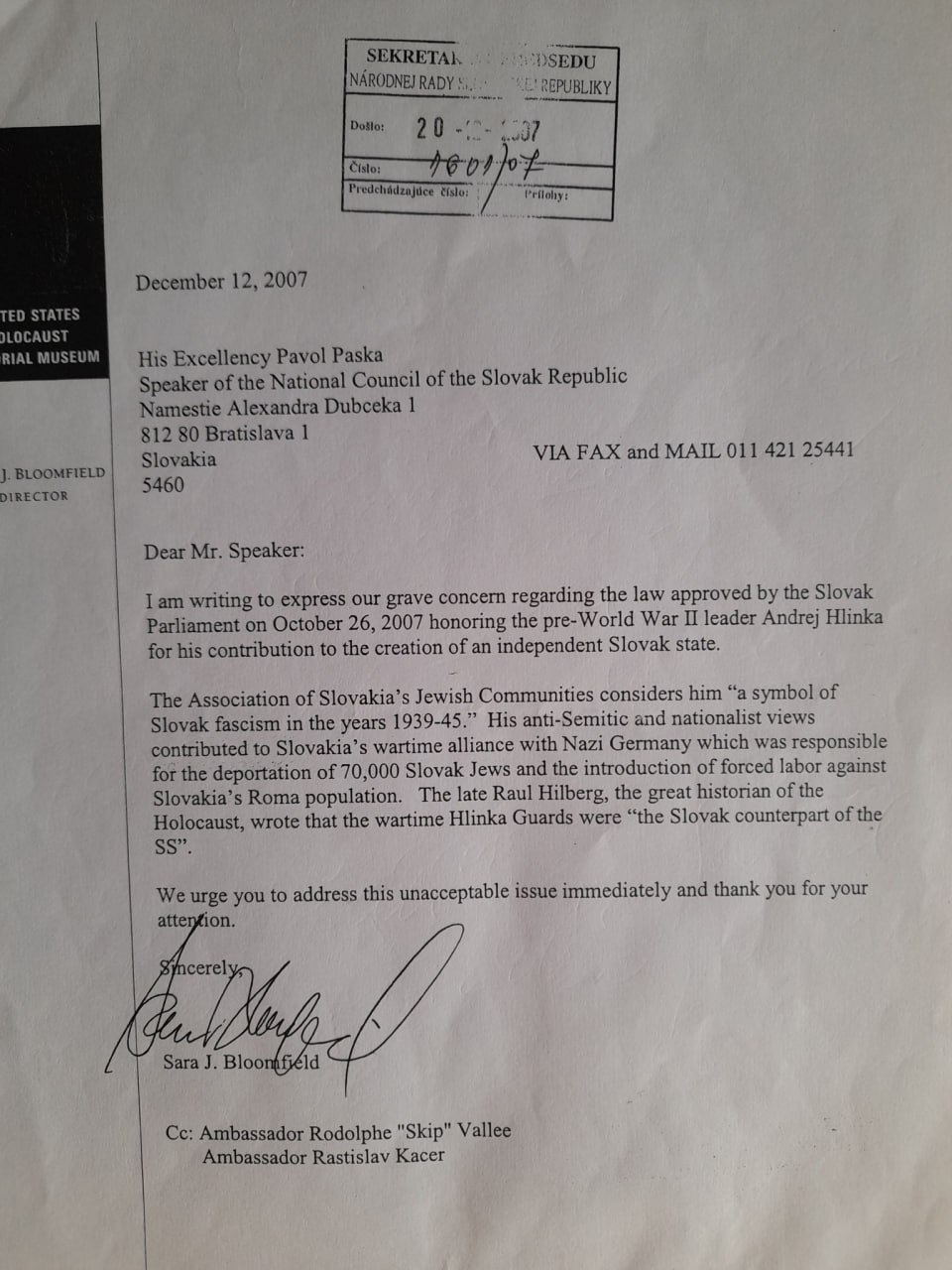
Dnes jeden príklad z roku 2008 – z obdobia, keď som pracoval ako prekladateľ v Parlamentnom inštitúte Kancelárii Národnej rady Slovenskej republiky. Niekedy po sviatku Troch kráľov ma zavolal riaditeľ Odboru medzinárodných vzťahov a protokolu Národnej rady, Dr. Bruno Hromý: „Michal, tentoraz je tu na teba prosba iného charakteru, nie preklad uznesení Národnej rady alebo prejavu predsedu parlamentu pána Pašku na konferencii, ale niečo iné. Si novinár a zároveň prekladateľ, Pán Paška dostal od riaditeľky Múzea holocaustu vo Washingtone, Sary Bloomfeld, ostrý protestný list proti Zákonu o zásluhách Andreja Hlinku o štátotvorný slovenský národ a o Slovenskú republiku, ktorý Národná rada schválila 26 októbra 2007. Židovské múzeum Holocaustu v USA ostro proti tomu protestuje a žiada od vedenia parlamentu okamžité vysvetlenie a odpoveď. List dostal v kópii na vedomie aj slovenský veľvyslanec v USA Rastislav Káčer a americký veľvyslanec na Slovensku R.“S“. Valle, lebo Múzeum to považuje za neakceptovateľné. Michal, vypracuj v angličtine odpoveď predsedu na ten list.
Spojil som sa s historikmi, vyžiadal som si potrebné dobové podklady a informácie historického charakteru a napísal som predsedov obsiahlejší list v angličtine. Poskytol som ho jednak Dr. Hromému a jednak som ho samozrejme poslal na sekretariát predsedu parlamentu. Desať dní bolo okolo toho ticho a ja som nevedel reakciu pána predsedu Pašku a nepoznal som osud toho listu. Po vyše týždni sa pýtam Bruna Hromého ako ten môj návrh listu dopadol. Bruno: „Michal, ten list je už vo Washingtone, pán predseda ho bez pripomienok hneď podpísal a poslal na všetky tri adresy, takže v pohode“.
Rozhodol som sa uverejniť tu pre zaujímavosť ten list Sary Bloomfeld, spolu s odpoveďou predsedu Pašku zo dňa 12. januára 2008 , ktorú som pre neho vypracoval. Tu je ten list:
12 January 2008
Dear Ms. Bloomfield:
Thank you for your letter of December 12, 2007, in which you expressed your concern regarding the law approved by the Slovak Parliament on October 26, 2007 honoring Andrej Hlinka for his contribution to the national emancipation and self-determination effort of the Slovak people and for the creation of an independent Slovak Republic.
Before I address the points raised in your letter I would like to emphasize some key facts about today’s Slovakia which, in my view, need to be taken into consideration in any constructive discourse concerning the nation’s past, present and future. First, I find it of paramount importance to point out that, as a member state of the Council of Europe, the European Union and NATO the Slovak Republic is a modern democracy built on the principles of respect for human rights and the rights of ethnic minorities. This is explicitly stated in the nation’s Constitution and the entire justice system of the country is developed in full conformity with the democratic and humanistic traditions and standards of the civilized Western world. Among other things this also means that Holocaust denial and any attempt to trivialize genocide of Jews or members of other ethnics in Nazi concentration camps, or encourage racial hatred and/or rekindle fascistic or fascizoid attitudes are outlawed. Slovak law enforcement authorities are constantly vigilant and take swift action if a transgressor needs to be brought to justice.
Right in the center of Bratislava’s Old Town stands a Holocaust memorial whose aim is to remind everyone of the Jews who were tortured to death during World War II. In this respect I also find it necessary to point out that the Slovak people are extremely proud of the courage and resolve with which the nation took up arms in the 1944 Slovak National Uprising against Nazism and Fascism.
On September 6, 2006, two months after I assumed office as Speaker, the Slovak Parliament adopted Common Declaration of the National Council of the Slovak Republic on the Occasion of the Commemoration Day of the Victims of Holocaust and Racial Violence and Against Manifestations of Extremism and Intolerance – a strongly worded political document in support of ethnic tolerance and peaceful coexistence in Europe. All this is vital to underscore before addressing the concerns expressed in your letter.
When the National Council of the Slovak Republic decided to approve the law honoring Andrej Hlinka it did so after careful deliberation during which his entire life and work were weighed in a facts-based historical retrospect. It was passed by a constitutional majority of 94 votes, with the leaders of all political parties represented in parliament, including those in opposition, voting for the motion. The only exception were Magyar Coalition Party MPs who voted against the bill (Andrej Hlinka fought fierce and at times brutal Magyarization of Slovaks in Great Hungary. That systematic Magyarization was the worst plague peoples of Central Europe were exposed to in the 19th and early 20th century, affecting all non-Magyar nationalities ruled by Budapest and leading to the eventual demise of Great Hungary after World War I).
Andrej Hlinka died in August 1938. He had nothing to do whatsoever with the wartime Guards that decided to misuse his name – an unfortunate move he could do absolutely nothing about since he already lay dead in his grave at the time of their forming. During his entire life Hlinka stood firm against Nazism and Communism, publically calling Adolf Hitler a “cultural beast” as soon as he saw what kind of oppressive regime the dreaded Nazi leader installed after he had come to power in Germany. Equally important from the point of view of your concerns is the fact that the Jewish community of the time spoke positively about Hlinka, even calling him “a great figure” in the Jewish Newspaper (Židovské noviny) shortly after his passing. The local Jews appreciated especially the peaceful coexistence of Christians and members of the Jewish community in the city of Ružomberok at the time when Hlinka served as Catholic priest in that Slovak city, adding in the Jewish Newspaper that he “held in esteem and honored his Jewish fellow citizens while spreading as a priest the spirit of religious tolerance”.
Another proof of Hlinka’s positive attitude toward Slovak Jews was his decision to ask two Jewish attorneys – Dr. Biheller and Dr. Hiller – to act as his defense lawyers during his trial before a Magyar court. Hlinka’s personal trust in Slovak Jews was reciprocated. When a petition was sent in 1909 to the ruling monarch calling for Hlinka to be released from jail it was signed by all the Jews living in the city of Ružomberok. The nature of Hlinka’s personal attitude toward Jews on a political level is apparent from the words he said to the then Vice-president of the Jewish Party Dr. Matej Weiner during their meeting in August 1936, three years after Hitler came to power: “I am no enemy of the Jews. The political party I lead is not anti-Semitic. Anti-Semitism is not our political agenda. As a catholic priest I am fully aware of the great moral, religious, and historical significance of Jewry for the entire civilized humankind, especially for the Christians”. These words had been quoted also by the foreign press of the period. Newspapers hostile to Hlinka, however, accused him of being friends with the Jews.
In February 1938, just months before dying, Hlinka criticized the conditions in Germany and refused cooperation of his political party with the representatives of the local German minority pro-Nazi parties supported by Berlin.
Hlinka’s role in the national emancipation movement of the Slovak people was truly great and indispensable. Although separated by centuries and geographical distance the aim, nature and direction of his strife is sometimes likened to that of Thomas Paine – known to Slovaks as one of the great fathers of American independence – despite the two men’s different philosophical platforms.
Hlinka’s face is on every Slovak thousand-crown bill, not without reason. Despite living in very difficult times he managed to maintain his moral integrity, had never been a political turncoat and showed personal courage to oppose evil whenever he saw one.
Having weighed very carefully every single aspect of Andrej Hlinka’s well-documented life the Slovak Parliament acted responsibly when it passed the law honoring him for what he had done for the nation in its emancipation struggle. Not only had Hlinka nothing to do with the wartime Guards but had he been alive during World War II, he would have opposed all the war atrocities with his heart.
Sincerely,
Pavol Paška
Ďakujeme, že ste našimi čitateľmi.
Naše sociálne siete:
facebook.com/ProgresivneCom
t.me/progresivne
instagram.com/nie_progresivne.
Musíš byť prihlásený pre poslanie komentára.